
A global standard for impact reporting is now in place
ISSUE 27 | SIIF Note: SIIFIC has published Japan’s first Impact Performance Report Norms-aligned report.

In March 2024, SIIFIC published the first impact performance report of the SIIFIC Wellness Fund, the “SIIFIC Impact Performance Report 2024.” This report was prepared in alignment with the Draft version of the Impact Performance Reporting Norms for private-market investors, which had been released by Impact Frontiers at the time.
In April 2024, Impact Frontiers then issued version 1 of these Norms. Building on our 2024 experience, SIIFIC published the “SIIFIC Impact Performance Report 2025” in accordance with the updated standard – Japan’s first report prepared under the Impact Performance Reporting Norms Version 1.
In 2025, Impact Frontiers released its list of Founding Adopters of the Norms.
Among them, SIIFIC is the only venture capital firm from Japan recognised as a “Whole Firm” Report Preparer, signalling that the Norms are adopted across our entire organisation.
This represents a meaningful step at a time when transparency and accountability are increasingly expected in impact investing, and shows that a Japanese venture capital firm has chosen to take an early, proactive role in aligning with global practice.
🔍 Why we adopted the Norms: from Draft to Version 1
The number of reports labelled “impact reports” has grown rapidly, yet their quality, depth and metrics have varied widely.
The Impact Performance Reporting Norms, developed by Impact Frontiers, offer an international common languageby:
Systematising what information should be disclosed so that investors can make decisions with a clear view of impact.
For the SIIFIC Impact Performance Report 2024, we chose to work with the Draft Norms ahead of the official launch, effectively embracing the comply-or-explain philosophy: even where impact measurement is not yet fully in place, high-quality, transparent disclosure is still possible.
With the SIIFIC Impact Performance Report 2025, we aligned with the Version 1 of the Norms. This has allowed us to present Japanese case studies to global audiences using a structure for content, governance and case studies that is consistent with international reporting practice.
🌏 A Japanese “Founding Adopter” in dialogue with the world
The Founding Adopters (report preparer) of the Impact Performance Reporting Norms include globally recognised impact investors such as Quona Capital, S2G Investments and Triodos Investment Management.
Within this group, SIIFIC stands as the only adopter from Japan taking a Whole-Firm approach. For us, this is an important step towards realising our ambition of communicating impact in a way that is fully intelligible and relevant to global investors.
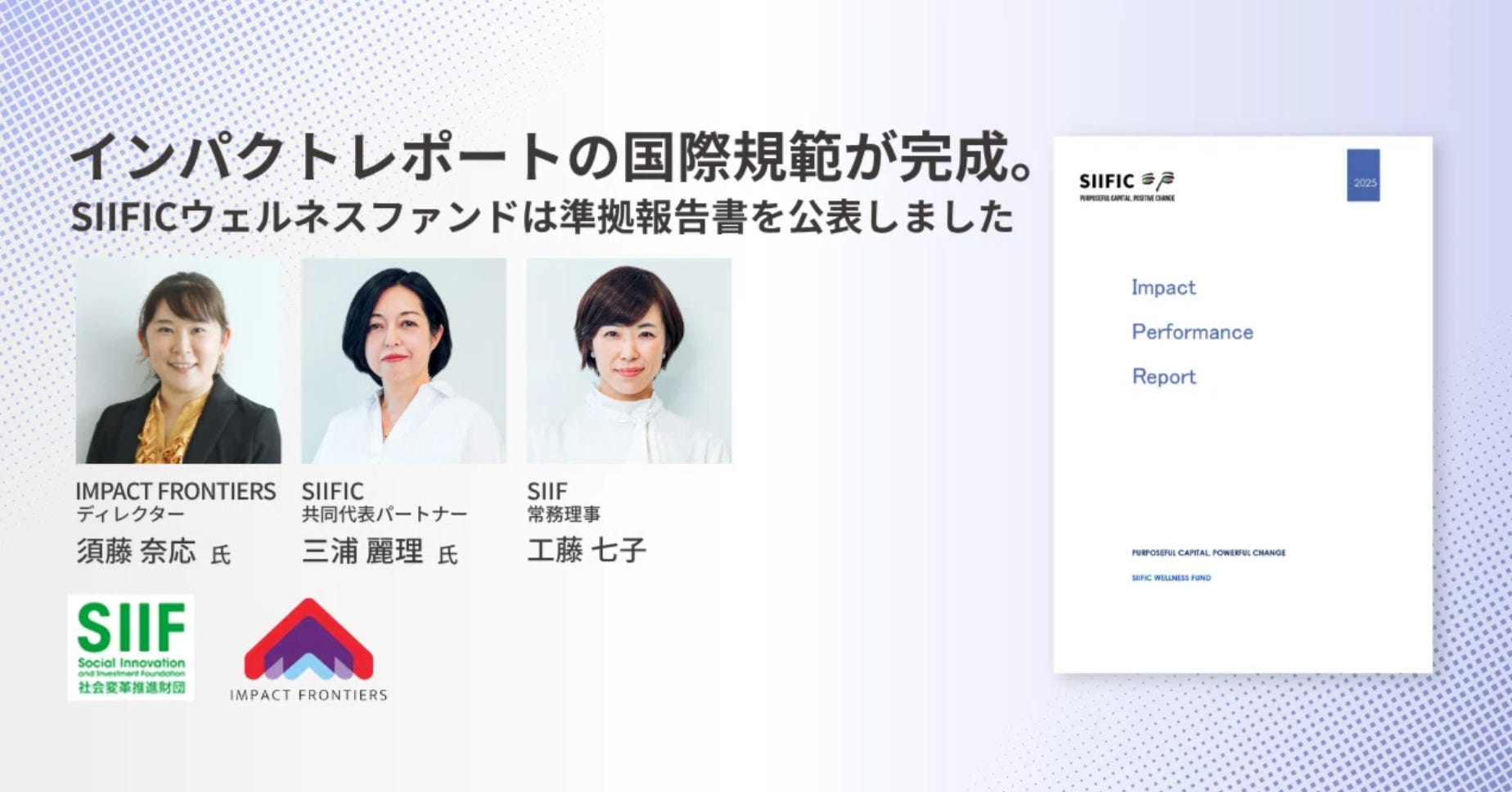
A Global Standard for Impact Reporting Is Now Complete
ーThe SIIFIC Wellness Fund Publishes Japan’s First Norms-Aligned Report
The SIIFIC Wellness Fund, jointly managed by SIIFIC and the Japan Social Innovation and Investment Foundation (SIIF), released the SIIFIC Impact Performance Report 2025 in April 2025.
This report is the first in Japan to be prepared in full accordance with the
Impact Performance Reporting Norms (“the Norms”), the global standard published by Impact Frontiers in April 2024.
In the latest SIIF Note article, Nao Sudo, Director at Impact Frontiers and a core contributor to the Norms, joins Reiri Miura, Founding Partner of SIIFIC, and Nanako Kudo, Executive Director of SIIF, to reflect on the development of the Norms and SIIFIC’s early adoption.
Impact reports can serve as essential inputs for investment decision-making through an impact lens
Nanako: To begin, could you explain what the Norms are? Why did Impact Frontiers decide to develop them?
Nao: For some time, it has been pointed out that the content of impact reports produced by impact investment funds varies widely in both quality and quantity. As the need emerged to build consensus across the industry, Impact Frontiers—an organisation experienced in consensus-building—stepped forward to take on the task.
We began work in 2022 and published a draft version in 2023. After collecting extensive feedback and refining the content, we reached the publication of the first edition in April 2024. Throughout this process, we spoke with over 350 stakeholders around the world, including asset managers, asset owners and allocators, consultants, and assurance/verification organisations.
Nanako: Indeed, many documents have been labeled “impact reports,” but until now there was no clear definition of what an impact report actually is. How do the Norms define the type of report they target?
Nao: The reports targeted by the Norms are those prepared by fund managers (GPs) managing private-market asset classes, intended for asset owners and allocators. Their purpose is to provide investors with the information necessary to make decisions through an impact lens. For other asset classes, such as listed equities, we believe additional guidance will be needed, and discussions are underway.
Even before impact KPIs are measurable, transparent disclosure is possible
Nanako: Could you explain why the SIIFIC Wellness Fund decided to adopt the Norms when preparing its impact report?
Reiri: For us, the Norms were a highly reliable and practical standard.
When we established the fund, we defined our “super goal” as the achievement of wellness equity. To translate that into concrete investment-selection criteria, we identified two leverage points: improving wellness literacy and strengthening social capital. From these, we established four investment themes. This allowed us to create a fund whose Theory of Change remained consistent.
Additionally, upon the fund’s establishment in June 2023, we became a signatory to the international impact investment framework, the Operating Principles for Impact Management. At that stage, we published our disclosure statement on impact management. We had also committed to publishing an impact report from the first year.
However, realistically, just six months after the fund’s establishment, we could not yet measure impact KPIs for our portfolio companies. Our first investment was J-Pharma, a drug discovery venture, and without multiple clinical trials and regulatory approval, the product cannot be commercialised. We were unsure how to report under such circumstances. It was at this moment that the draft Norms were released.
As Nao mentioned, the Norms are premised on a comply-or-explain approach. Even if full compliance is not immediately possible, one can credibly explain why. This approach was perfectly suited to a young fund like ours. We believed that following the Norms would allow us to achieve a high degree of transparency in our reporting.
Nanako: In SIIFIC’s Impact Performance Report 2025, the items required by the Norms are transcribed as-is, and for any item that could not yet be disclosed, the report clearly states so. The structure makes it easy to distinguish what has been completed and what has not.
Reiri: We believed that adhering to the Norms in itself would provide reassurance to LPs. In fact, LPs have evaluated positively our willingness to disclose without using the inability to measure KPIs as an excuse.
Furthermore, because the Norms are designed for investors, they are highly compatible with the SIIFIC Wellness Fund’s aim of pursuing both financial returns and impact.
Sharing the reporting process with portfolio companies as a collective learning exercise
Nanako: What were your impressions from actually preparing a report using the Norms?
Reiri: The Norms are organised in a very clear structure. By writing the report in accordance with this structure, we found that our own thinking became more organised. Although we had established an impact management system at the time of the fund’s formation, translating it into this format improved its visibility.
Also, while the report is intended for investors, it proved extremely useful in communicating with our portfolio companies.
Most of our portfolio companies are engaging in impact management for the first time. Instead of simply requesting that they implement IMM, we shared the reporting process itself as a collective learning exercise—starting with discussions about the background of our firm and our investment track record. This allowed us to build shared understanding of impact before beginning due diligence, and to revisit the company’s mission and corporate values together. It was also a good opportunity to introduce key impact concepts and terminology.
Nao: I was deeply impressed by the dedication and determination shown by Reiri and the SIIFIC team in tackling the Norms at the draft stage. That said, wasn’t the process difficult?
Reiri: To be honest, because a “textbook” arrived at exactly the right moment, we seized it immediately (laughs). Surprisingly, it wasn’t as difficult as one might think. A major strength of the Norms is that the disclosure statement we prepared when signing the Impact Principles could be used directly. Without that, it might have taken much longer.
Also, because the Norms resemble IFRS or statutory filings rather than visually appealing reports full of photos or emotional stories, the format felt very familiar to me with my background in corporate planning.
Nanako: The Norms are deliberately simple in format, correct?
Nao: Yes. When drafting the Norms, our reference point was essentially “an impact version of a statutory financial report.” Initially, we intended not to include any photos or illustrations. However, during public comment, many stakeholders expressed that relevant photos enhance understanding, so they were ultimately permitted.
Case studies were also elevated from optional to mandatory because many investors consider them essential. At the same time, readers need clarity on whether a case is representative or exceptional, so the Norms now provide guidance on selection and categorisation.
Nanako: How do you view SIIFIC’s Impact Performance Report 2025?
Nanako: I was impressed that the report clearly sets out a schedule for disclosing performance items that cannot yet be provided. Its governance section is also thorough and transparent. I look forward to seeing how future reports present performance data.
Starting with fixed items that do not require annual updates
Nanako: After publishing the first edition, Impact Frontiers has launched pilot programmes in various countries. Based on what you’ve heard so far, do you have advice for those preparing their first report?
Nao: My advice is: there is no need to aim for perfection from the beginning. Start where you can. I recommend beginning with items that do not need to be updated annually—for example:
Entity overview and impact thesis
Impact management approach
Governance
Performance disclosures can begin in the second year.
When preparing the report, it is best to consult with the LPs who will be reading it. In our pilot programmes, both report preparers and investors engage together, as the reader’s perspective is crucial.
Nanako: What topics are likely to be points of discussion going forward?
Nao: Questions about performance disclosure are frequent. The Norms state that impact performance for all investees should be disclosed “to the extent possible.” For asset owners, however, assessing portfolio-level impact presents challenges. The Norms offer several illustrative approaches.
The voice of end-beneficiaries—how and when it should be incorporated—is also a major theme. Additionally, investor contribution remains an ongoing area of discussion.
Reiri: In the SIIFIC Wellness Fund, we sign IMM MOUs with each portfolio company and publish their ToCs. Except for cases where regulatory constraints limit disclosure, we expect to be able to provide performance data. However, in some funds, different impact investors may have set different KPIs for the same company, which would require coordination.
Similarly, investor contribution may be more difficult to articulate for later-stage companies compared with early-stage ventures, where our hands-on involvement (including compliance training and policy development) is clearer.
Continuing to ask ourselves: What is impact? What can investors do?
Nanako: The Norms can also be seen as a set of questions directed at impact funds. Facing these questions annually seems valuable for the fund itself. Although the total size of Japan’s impact investing market has grown, impact management, measurement, and strategy are still developing.
Nao: Japan’s impact investing sector is entering a new stage. As more people and capital enter the field, continuously asking “What is impact?” and “What should investors do to contribute to impact?” becomes even more important.
This is why, in both the Norms’ pilot programmes and the upcoming course “Introduction to Impact Management through Case Studies,” we emphasise dialogue. As Impact Frontiers’ Asia lead, I aim to extend Japan’s learnings to Asia and contribute to capital circulation across the region.
Reiri: Japan’s impact investing market reached JPY 17.3016 trillion in FY2024. With a market of this scale, impact funds will increasingly be expected to deliver results—both financial and impact.
According to the GIIN, impact investing is defined as “investments made with the intention to generate positive, measurable social and environmental impact alongside a financial return.” For impact funds, “results” therefore comprise both financial returns and impact returns.
Startups sometimes ask whether disclosing impact leads to higher corporate valuation. We believe not directly, but disclosure of intended impact and KPI achievement fosters understanding and recognition. We intend to incorporate impact—such as ToCs and system maps—into the “Part I” of securities filings for companies preparing to list.
Impact is a language that works globally. We prepared the Impact Performance Report 2025 in English, and this has allowed us to share Japanese cases internationally. We have already received inquiries from investors in Asia and the UK. By communicating using a common language—impact—and aligning with an international standard like the Norms, we can connect to global markets.
We encourage asset owners, allocators, policymakers, researchers and all practitioners to actively use the Impact Performance Reporting Norms as a practical tool in your own work. Whether you are evaluating fund managers, shaping investment strategy, designing IMM processes or conducting research, the Norms offer a clear, comparable and globally consistent framework. By engaging with the Norms as Report Users, you help strengthen a shared language for impact and contribute to a more transparent, accountable and outcomes-oriented investment ecosystem — in Japan and around the world.